



Beveled edge hardwood has a small angled cut along each board edge, so every seam shows as a thin groove. Square edge boards have no cut, so they meet flat and the floor reads as one surface. The bevel adds definition but holds dust and grit in the seams. The square edge looks calmer and wipes clean faster, but on prefinished or unsanded installs, or over an uneven subfloor, it shows height differences (lippage) between boards.
What the two edges actually are
A square edge board has a sharp 90-degree corner on the top face. Pull two boards tight and the seam nearly disappears. Most floors finished on site are square edge. The installer sands the whole surface flat after nailing, and any small step between boards gets cut away.
A beveled board has a small angled cut along the long edges, and sometimes the ends. The depth is often a sixteenth of an inch or less. A micro bevel is shallower still. Most prefinished floors are beveled, because the factory finishes the boards and nobody sands them flat afterward. The bevel hides the small height differences that come from board to board.
Not every prefinished board is beveled. Check the sample edge rather than assuming.
What you see in the room
Bevels draw a line around every board. The floor reads as individual planks. A square edge floor hides those lines, so the look comes from the grain and the color instead.
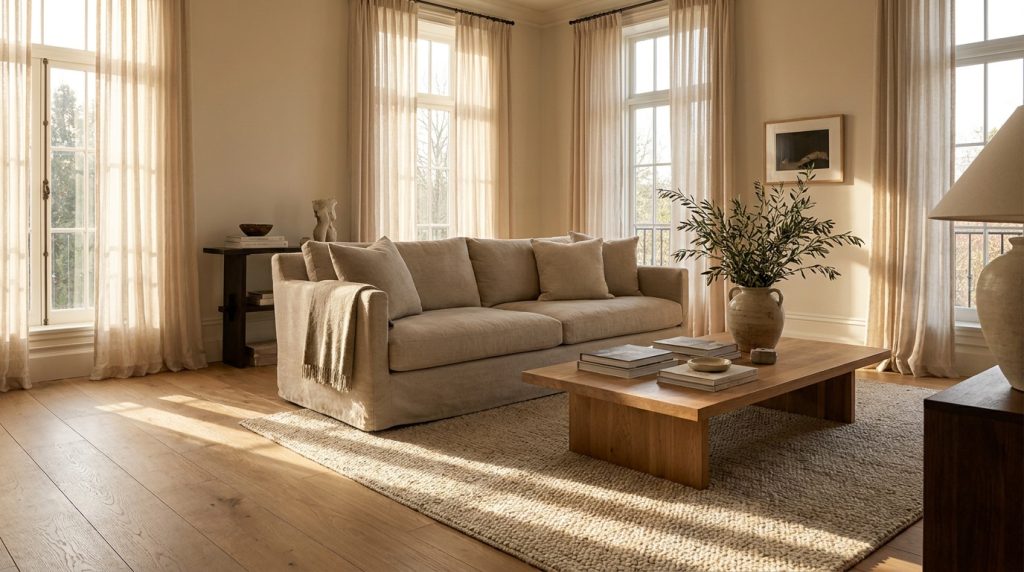
Light changes the picture. Low sun coming across the floor from a tall window or patio door makes bevel lines stand out. It also makes any step between square edge boards show as a thin shadow. Neither edge is immune.
Board width matters too. Narrow strips put more seams in a room, so a bevel makes the floor look busier. A wide plank has fewer seams, and the bevel reads more like a deliberate detail.
Then there is winter. Boards shrink in dry air and seams open slightly. On a square edge floor that shows as a hairline crack. On a beveled floor the gap blends into the groove, though the groove can look a little wider. Our post on how Atlanta humidity changes hardwood floors by season explains the cycle. Keeping indoor humidity within the flooring manufacturer’s stated range, commonly 30 to 50 percent or 35 to 55 percent, helps limit seasonal movement.
What you clean
This is the part people overlook when they pick a sample. Square edge floors are simple. A dust mop or vacuum picks up everything on a flat surface. Beveled floors have a groove on every board. Grit, pet hair and crumbs settle there, and a flat dust mop skips right over them.
Grit that stays in a groove gets walked on. Over time it can dull the finish along the edge. Here is the routine we suggest for a beveled floor:
- Vacuum with a soft brush head on the hard floor setting. Run it along the length of the boards, not across.
- Do it weekly at minimum. Do it twice a week with pets or during spring pollen.
- Mop with a cloth or mop wrung nearly dry. Water pools in a groove and sits longer than on a flat face, so dry the surface within a minute or two.
- Wipe spills right away.
- Skip steam mops. Steam drives moisture into the seams.
A square edge floor follows the same routine, and the vacuuming goes quicker. Our guide on how to clean hardwood floors covers the technique in more detail.
Square edge vs beveled edge, side by side
| Feature | Square edge | Beveled edge |
|---|---|---|
| Look | One continuous surface | Defined line around each board |
| Seam | Hairline when tight | Visible groove, often 1/16 inch or less |
| Dust and grit | Little collects | Collects in the groove |
| Height differences | Sanded flat on site-finished floors; show as a step on prefinished, unsanded or uneven installs | Mostly hidden |
| Common use | Site-finished solid floors | Prefinished solid and engineered floors |
| Refinishing | Sanded flat each time | Bevel gets shallower with each sanding |
What happens when you refinish
A square edge floor finished on site can be sanded several times over its life. The grit sequence typically starts around 36 to 60 and steps up to 80 or 100. The surface stays flat and the edges stay square. Our hardwood floor restoration work starts by checking how much wood is left to work with.
A beveled floor behaves differently under a full sanding. Each pass takes wood off the top surface, so the groove gets shallower and the lines soften. Some homeowners like that. Others want the bevel gone entirely, but that removes more wood than a normal refinish. On engineered boards the wear layer may not allow it. We cover that in can you refinish engineered hardwood floors.
A screen and recoat leaves the bevel alone, with one catch. Vacuum the grooves thoroughly first. Anything left in there gets sealed under the new coat. See screening and recoat vs full refinish to decide which service your floor needs.
Sheen helps too. A matte or low-sheen finish hides fine dust in a bevel better than a high gloss. Our matte vs satin comparison goes into it.
How to choose: check this first, then this
- Prefinished or site-finished? If you want the floor sanded and finished in the house, square edge is the natural fit. If you want a factory finish, you are mostly looking at bevels.
- How flat is the subfloor? It typically needs to be within about 3/16 inch over 10 feet. A bevel forgives small steps, but flattening the subfloor is the real fix.
- How much light crosses the floor? Tall windows and patio doors highlight either edge. Look at samples in that light, not under store lighting.
- Who walks on it? Dogs, kids and a garage entry bring grit. If vacuuming along grooves sounds like a chore, favor square edge.
- Will you refinish? If you expect to sand more than once, ask how much wear layer or wood is above the tongue before you buy.
Homeowners in Alpharetta often ask us this when they are choosing between prefinished and site-finished boards. Our hardwood flooring installation work covers both, so the choice can follow your rooms rather than the other way around.
Neither edge is better in every house. The right one matches how you clean and what you want to see. A floor you can keep up looks better in year ten than one that was only perfect on install day.
Not sure which edge fits your rooms? Request a free estimate or call 404-578-0926, and we will look at your subfloor and lighting with you.
Frequently asked questions
Square edge is easier because there is no groove for dust, grit and pet hair to settle in. Beveled floors clean up fine with a soft-brush vacuum run along the boards, but they need that extra step.
On solid boards it can be done, but it removes more wood than a normal refinish. On engineered boards the wear layer may be too thin to allow it, so check before you commit.
A wiped-up spill is not a problem. The groove holds liquid longer than a flat surface, though, so standing water or a soaking-wet mop can reach the seam sooner.
Usually, yes. When boards shrink in dry weather, the gap shows as a thin crack on a square edge floor. On a beveled floor it blends into the groove.
No. The edge is a design and manufacturing choice. Beveled boards are common on prefinished floors because the bevel hides small height differences between boards.
Keep reading
- Why You Need Hardwood Floor Refinishing
- What’s the Difference Between Prefinished and Unfinished Hardwood Floors?
- Hardwood Floor Refinishing in Alpharetta, Ga