



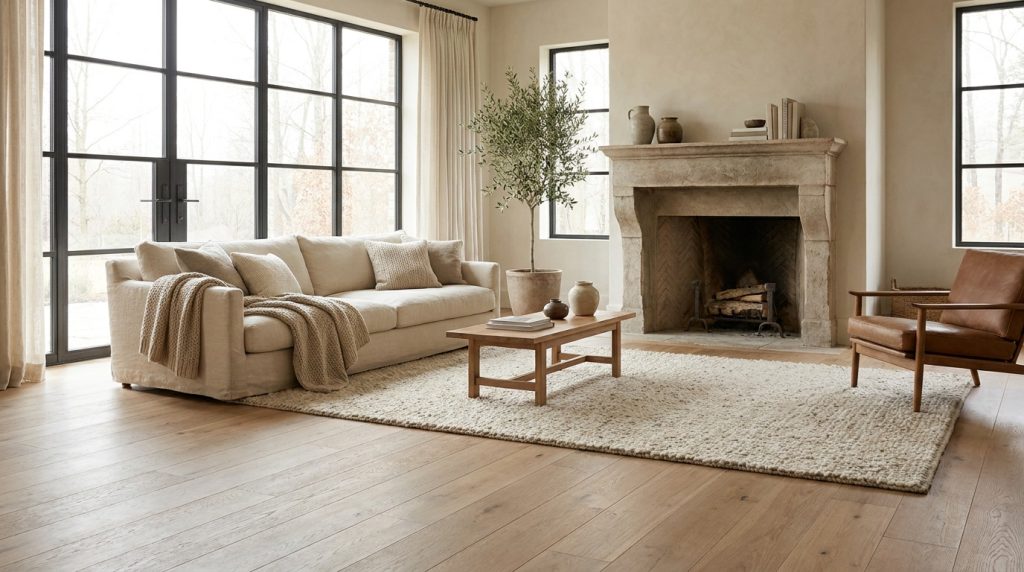
Radiant heat under hardwood works well with engineered boards. It also works with narrow, stable solid boards when the install is careful. It works poorly with wide solid planks, and with any floor laid over a slab that has not dried. The heat itself is rarely the whole problem; moisture and fast temperature swings do most of the damage.
Why heat is hard on wood
Wood gives up moisture as it warms, and it shrinks as it dries. Heat from below dries the underside of a board first. That bottom face shrinks, and the board tends to crown, with the edges turning down. Across a whole floor, the shrinkage shows up as gaps at the seams.
Cupping usually points the other way. It means the bottom of the board is wetter than the top, often because of moisture rising from the slab.
Wide boards have more width to shrink, so they move more. A narrow board has less room to misbehave. That one fact drives most of what follows.
Heating season also dries the air in the house. Our seasonal humidity guide covers how much wood moves in Georgia without any radiant system. Radiant heat adds to that movement, so it helps to keep indoor humidity in the 30 to 50 percent range.
Which floors work and which do not
| Floor type | Radiant suitability | What to know |
|---|---|---|
| Engineered, plywood-style core, up to about 7 inches wide | Best choice | Cross-layered core resists movement. Check the wear layer if you expect to refinish. |
| Solid, quartersawn or rift-sawn, 3 inches or less | Good | Cut for stability. Expect hairline seasonal gaps. |
| Solid, plain-sawn, 2-1/4 to 3 inches | Workable | Needs a dry subfloor and slow heat-up. |
| Solid, 5 inches or wider | Poor | Gaps and cracks between boards are likely. |
| Thick solid planks over a slab | Poor | Thickness slows heat transfer, so the system has to work harder to warm the surface. |
Species matters too. Hickory and maple typically move more with moisture changes than many oaks do. If you are choosing a floor for a heated room, ask about the cut of the board, not just the species.
If you want to compare engineered styles, our engineered hardwood options post is a good start. For hardwood in heated rooms, our hardwood flooring installation team can walk the space with you.
How these floors fail
These are the failure modes we see in heated floors:
- Gaps along every seam. The heat was pushed up too fast, or the boards were too wide.
- Crowned boards. The underside dried and shrank faster than the top, so the edges sit lower than the center.
- Cupped edges. Usually moisture coming up from the slab or subfloor, wetting the bottom of the board. Our post on why hardwood cups explains the mechanism.
- Cracked boards. Surface temperature ran too hot, or a thick rug trapped heat.
- Punctured tubing or a damaged element. A fastener hit a line nobody had mapped.
- Warm and cold stripes. Rugs and heavy furniture blocked the heat in some places.
The order we check things
- Identify the system. In-slab water tubing, tubing under the subfloor, and electric mats all behave differently.
- Test the moisture. Slab drying time depends on thickness, mix and conditions. It is roughly a month per inch of thickness, and often longer for thick slabs or humid conditions. Do not judge by elapsed days. Use a moisture test, such as calcium chloride or an in-slab RH probe. Wood goes down only when the slab and the boards are both in range.
- Pick the board. Choose engineered or narrow stable solid, as the table shows.
- Pick the install method. Glue-down and floating engineered floors are common over heat. Nailing needs a known tube layout, because fasteners are often 1 to 2 inches long. Our comparison of install methods explains the tradeoffs.
- Plan the rugs. Thick rugs and pads act as insulation. Choose thin ones.
- Plan the startup. This is covered below.
Running the heat the right way
Run the system before the wood arrives, so the slab is warm and dry. Then turn it down to a normal temperature during the install.
After install, raise the temperature a few degrees a day rather than all at once. Follow the flooring manufacturer’s maximum surface temperature, generally no higher than 80 to 85°F. Excess heat and fast changes increase the risk of gaps and splits. Set the thermostat conservatively and let the room settle.
The same slow approach helps with finish. Heat can speed surface drying, but the coating still needs time. Our post on dry time versus cure time explains why.
One more point on engineered floors: the wear layer limits how many times you can sand. Read what to check before refinishing engineered floors before you buy.
If radiant heat is the priority and wood is not, luxury vinyl and tile are common alternatives. See our luxury vinyl plank installation page for that option. Homeowners in Alpharetta ask us about this often, especially in winter.
If you are planning hardwood over radiant heat, we can look at your slab, your system, and your boards before anything is ordered. Request a free estimate at our contact page or call 404-578-0926.
Frequently asked questions
Often yes, if the boards are narrow (typically 3 inches or less), the subfloor is dry, and the heat is brought up slowly. Wide solid planks are much more likely to gap or crack.
Engineered hardwood with a plywood-style core is usually the safest choice because its cross-layered build moves less with heat and humidity. Narrow, quartersawn or rift-sawn solid boards are the next best option.
Follow the flooring manufacturer’s maximum surface temperature, which is generally no higher than 80-85°F. Excess heat and fast changes increase the risk of gaps and splits.
Keep reading
- How to Protect Hardwood Flooring From Wear (Simple Habits That Work)
- Why You Should Consider Hardwood Flooring Over Laminate
- Why You Should Choose Hardwood Flooring