



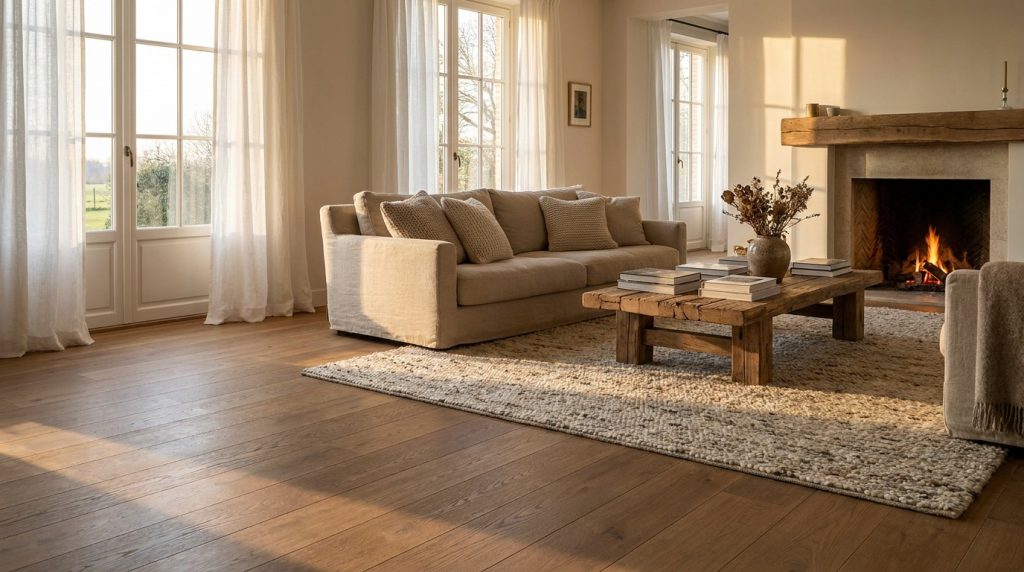
Hardwood floor stain looks different on every species, even from the same can. Oak has open pores that soak up stain and show the grain. Maple is dense and tight, so stain can go on blotchy. Hickory swings in natural color from board to board, and stain narrows that range without erasing it.
Why the same stain varies by species
Stain is pigment or dye carried into the top surface of the wood. How much gets in depends on pore size, density and how the floor was sanded.
Open-pored wood takes more. Dense wood takes less, and it takes it unevenly. Everything below follows from that.
Sanding matters too. Before stain, installers typically stop somewhere between 80 and 120 grit, depending on the species and the color goal. Sanding finer closes the surface, and the color comes out lighter.
Oak: open grain and a strong undertone
Oak is the most forgiving of the three. The large pores fill with stain, and the grain lines read darker than the wood around them. That gives oak its textured look.
The undertone is the catch. Red oak runs pink to warm brown, so a light or neutral stain often looks warmer on the floor than on the sample chip. White oak is more tan to olive-brown, and it generally takes gray-brown and natural tones more cleanly. Our post on white oak vs red oak covers the structural differences.
The cut changes the result as well. Plain-sawn boards show cathedral grain. Rift and quartersawn boards look straighter and calmer, as we explain in plain sawn vs rift vs quartersawn.
Texture counts too. On a wire-brushed floor, stain settles into the brushed grooves. The floor reads darker, with more contrast, than a smooth board in the same color. We compare the two looks in wire-brushed vs hand-scraped.
Maple: tight grain and blotch risk
Maple is pale, hard and nearly pore-free. Stain has little to grip, so it sinks in unevenly. Patches soak up more color where the grain changes direction, and you get a blotchy, almost cloudy look.
Dark stains show it most. So does figured maple with curl or wavy grain.
There are ways to manage it:
- A pre-stain conditioner partly seals the surface so color goes in more evenly.
- A lighter stain, applied in thin coats, hides less and blotches less.
- A dye or toner can build color more evenly than a pigmented stain.
- A clear finish avoids stain blotching, and a water-based clear keeps maple lightest.
Keep in mind that maple does not stay exactly as installed. Oil-based finishes add an amber tone, and all maple shifts color with age and light.
Even with these steps, stained maple can look more varied than oak. Some homeowners like that. Others choose a clear finish once they see a test patch.
Hickory: stain narrows the contrast, it does not remove it
Hickory is the hardest of the three. A single floor can mix pale sapwood with brown to reddish heartwood, sometimes in the same board. That contrast is the character of the species.
Stain evens it out, but only partly. A dark stain pulls the range closer together. A light or natural finish makes the swings stand out. Hickory is also dense enough to absorb unevenly in places, so the color can look streaky until the coats build.
The grade you buy affects how wide the color range runs. Our hardwood grades post explains what each grade allows.
How the three compare
| Species | Grain | How stain behaves | What to watch |
|---|---|---|---|
| Red oak | Open, pronounced | Absorbs well, grain darkens | Pink undertone shows through light and neutral colors |
| White oak | Open, often straighter | Absorbs well, accepts gray-brown tones | Tan to olive undertone |
| Maple | Tight, nearly closed | Absorbs unevenly | Blotching, especially with dark colors |
| Hickory | Moderately open, hard | Absorbs unevenly in spots | Large sapwood and heartwood color swings |
What to settle before you choose a color
Start with the species, then the color you want, then a test. In that order.
Ask for a sample on the real floor. It should be sanded to the same grit as the job and finished with the same topcoat. The finish shifts color. Oil-based finishes add an amber tone, while water-based finishes stay clearer.
Check several boards, not one. On hickory and maple especially, one patch can mislead you.
Plan for drying time. For oil-based stain, follow the stain manufacturer’s recoat window, commonly 24 hours or more. Cool or humid conditions can stretch that. Water-based stain often dries in a few hours. Humid weeks affect results, as we describe in how Atlanta humidity changes hardwood floors. After the topcoat goes on, the floor is dry long before it is cured; see dry time vs cure time before you move furniture back.
Existing floors need a different approach. To change a stain color, the floor usually has to be sanded back to bare wood. That is the work behind our hardwood floor restoration and refinishing. Some changes don’t need that, such as a screen-and-recoat with a tinted finish, or a gel or toner over a sound existing finish. Engineered floors have a limited wear layer, so check what is left before planning a color change. Our post on refinishing engineered hardwood explains what to look for.
For new floors, hardwood flooring installation gives you a choice. Prefinished boards come with a factory color. Unfinished boards are stained on site, so you pick the color and see it on your own wood. Homeowners in Alpharetta ask us about this choice often, usually when they are torn between a pale maple look and a richer oak.
If you want to see stain samples on your own floor, we offer a free estimate. Request one at our contact page or call 404-578-0926.
Keep reading
- Why You Need Hardwood Floor Refinishing
- Hardwood Floor Refinishing in Alpharetta, Ga
- Hardwood Floor Refinishing Mistakes to Avoid