



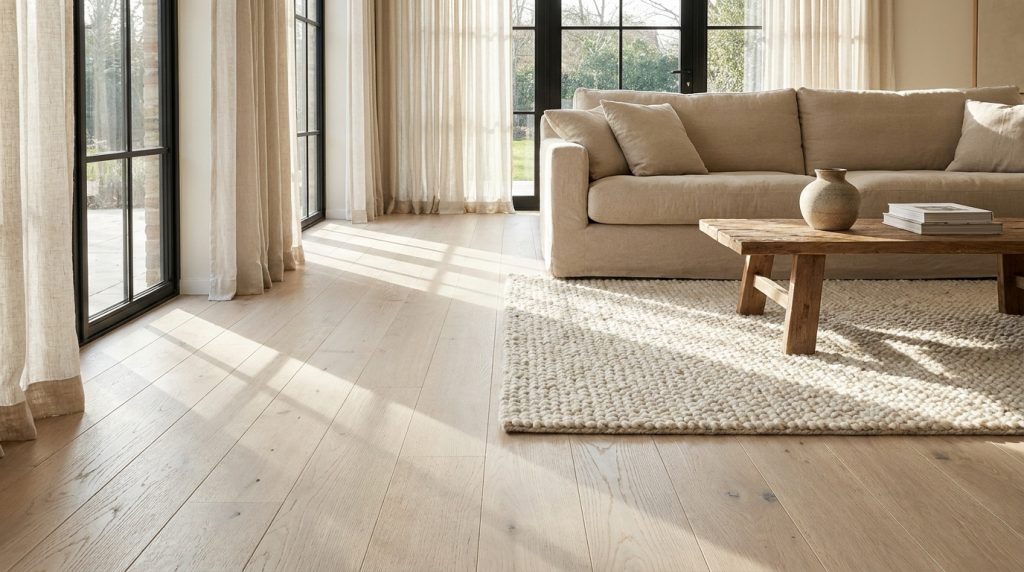
Wire brushed hardwood has a shallow texture that follows the grain, so it hides light wear and cleans up with the right tools. Hand-scraped hardwood has deeper, uneven dips that make fine wear less noticeable but collect more dirt and are harder to refinish. Both work well in real homes when the texture matches how the room is used. Trouble starts when it is chosen from a showroom photo alone.
What each texture actually is
Wire brushing is done at the mill. Rotating wire brushes pull out the softer, lighter part of each growth ring. The harder, darker grain stays raised. You get a surface you can feel, with grain that reads clearly. It suits open-grained species such as oak best, and it is typically shallow, so the boards still sit nearly flat.
Hand scraping is rougher. Tools cut shallow dips and ridges across the face of each board, so no two boards match. Some floors are scraped by hand. Others are distressed by machine to imitate it. The dips are often around 1/32 to 1/16 inch deep, and the edges are usually beveled, which adds to the worn look. Our post on square edge versus beveled edge hardwood covers how those edges affect cleaning.
Neither texture changes the wood underneath. It is still the same board, with the same species, the same movement, and the same installation needs.
Where texture helps
- Fine scratches are less noticeable. On a smooth board, a fine scratch is a bright line. On a textured board, it blends into the surface. Deep scratches and gouges still show.
- Dust and footprints show less. Dark, glossy smooth floors show everything. Texture breaks up the light.
- Small edge differences fade. No installed floor is perfectly flat at every seam. Texture and bevels make tiny height differences between boards far less noticeable.
- It suits character grades. Knots and color variation look intentional on a scraped board. If you are weighing that look, read about hardwood grades from select to rustic.
- It pairs with low sheen. Texture and a matte finish look natural together. We compare finishes in matte versus satin hardwood finish.
For households with dogs, the surface helps with fine scratches. It does not stop long nails from gouging. Our guide to pet friendly flooring goes further on that.
Where texture causes trouble
Dirt is the first complaint. Grit and crumbs settle into the grain and the beveled edges. A broom pushes some of it around. A vacuum with a soft brush head pulls it out. A barely damp microfiber mop finishes the job. Soaking a textured floor with water is a mistake, because the liquid pools in the dips.
Feel is the second. Wire brushed boards feel slightly rough underfoot. Hand-scraped boards can feel uneven to bare feet, and some people never get used to it.
Furniture is the third. Chair legs and table feet can rock on scraped dips. Rolling office chairs struggle. Felt pads help, but they do not level a dip.
Repairs are the fourth. Replacing one damaged board is harder than on a smooth floor. A new board’s texture rarely matches the surrounding ones, especially on hand-scraped floors.
Finally, glossy finishes look wrong on texture. The sheen exaggerates every ridge and shows uneven coverage.
Side by side
| Question | Wire brushed | Hand-scraped | Smooth |
|---|---|---|---|
| Texture depth | Shallow, follows grain | Deeper, random dips | None |
| Hides fine scratches | Well | Very well | Poorly |
| Dirt in surface | Some | Most | Least |
| Furniture sits steady | Yes | Sometimes rocks | Yes |
| Screen and recoat | Keeps texture | Keeps texture | Easy |
| Full sanding | Texture mostly lost | Texture largely lost | Fresh start |
| Spot repair | Moderate | Hardest to blend | Easiest |
What happens when you refinish
This is the part buyers rarely hear. A full sanding cuts the surface down to flat wood, so it removes most of the texture. On a hand-scraped floor, the dips are largely sanded away. Wire brushed texture mostly goes too, and re-brushing on site is not something to count on.
A screen and recoat is different. It abrades only the finish and adds a new coat, so the texture stays. That makes timely maintenance more important on textured floors. Once the finish wears through in traffic lanes, your choices narrow. Our hardwood floor restoration and refinishing team can look at a floor and tell you which route is still open.
Engineered plank adds a limit. Both textures take wood off the top, and the wear layer is often only a few millimeters. Ask for the actual wear layer thickness before you order. A thin one leaves little to sand later.
Humidity does not care about texture
Textured boards still swell and shrink with the seasons. Indoor humidity is commonly kept around 30 to 50 percent, but follow your manufacturer’s published range for the product you buy. Bevels and texture make a small winter gap a bit less visible, but they do not prevent it. Read how Atlanta humidity changes hardwood floors by season so the first January gap does not come as a surprise.
Matching texture to the room
- Kitchens and entries: Wire brushed is usually the easier choice. Crumbs and grit are constant here, and the shallower surface is easier to clean. Hand-scraped also works, with more cleaning. If you are redoing cabinets too, our kitchen remodeling work can be planned around the floor.
- Family rooms with pets or kids: Either works. Hand-scraped makes the most fine wear less noticeable, if you accept more vacuuming.
- Bedrooms and living rooms: Hand-scraped suits wide planks and a lived-in look, and the traffic is lighter.
- Rooms with rolling chairs: Lean toward wire brushed or smooth.
Before you commit, take a full-size sample home. Look at it in morning and evening light. Set a chair on it, drag a sock across it, and drop a few crumbs on it. A week with the sample tells you more than any catalog.
Homeowners in Alpharetta ask us this often, usually holding two samples and unsure which one to live with. We install both through our hardwood flooring installation service, and the answer almost always comes down to the room and the people using it.
Still unsure which texture fits your home? We can look at the room with you and talk it through. Request a free estimate or call 404-578-0926.
Frequently asked questions
Slightly. Dust and crumbs settle into the grain, so a soft-brush vacuum works better than a broom alone. Follow with a barely damp microfiber mop.
You can, but a full sanding removes much of the scraped texture. A screen and recoat keeps the texture and renews the finish, as long as the floor has not worn through.
They make fine surface scratches less noticeable, because the eye reads them as part of the texture. Deep gouges and worn-through finish still show, and long nails can still dig in.
Wire brushed is usually easier in a kitchen because the surface is shallower and crumbs are simpler to remove. Hand-scraped works there too, but expect more sweeping and more dirt in the dips and bevels.
Keep reading
- Wide Plank vs Traditional: What Hardwood Flooring is Right for You?
- Why Should You Choose Wide-Plank Flooring for Your Home?
- What’s the Difference Between Prefinished and Unfinished Hardwood Floors?